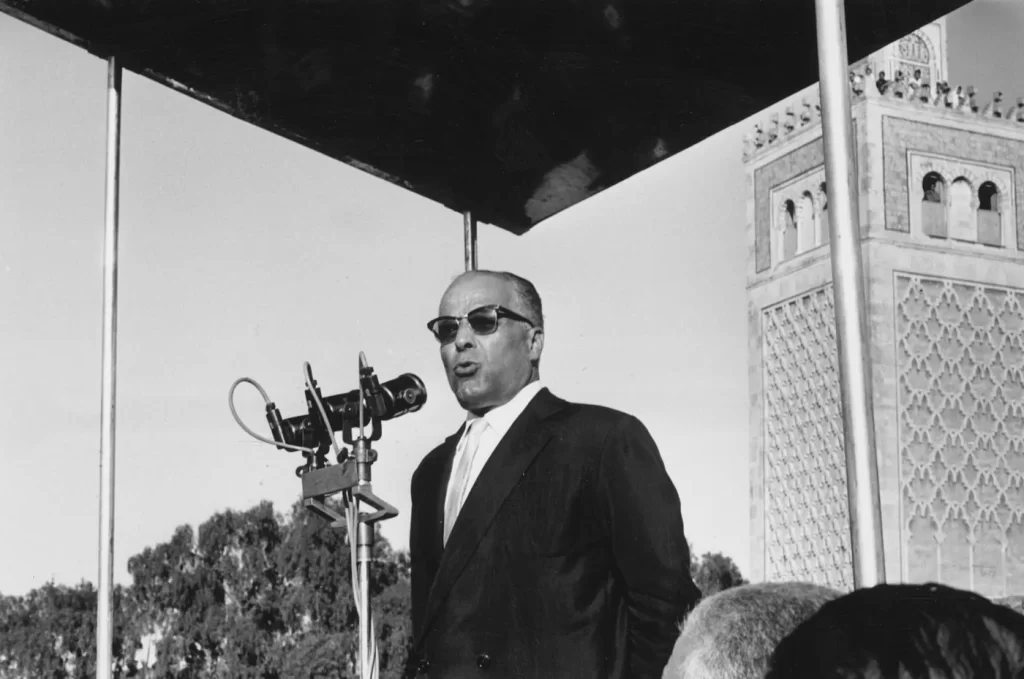
source www.arsipjatim.go.id
INTRODUCTION
This article analyzes the intellectual origins, objectives and the growth of Indonesian’s largest post-independence Islamic political party, Masjumi. The analysis will concentrate on the idea of Islah and Tajdid and how it was demonstrated by Masjumi in Indonesian political discourse. The study of Masjumi will also give us some idea in how the political representatives of this Ummah struggle to achieve consensus regarding the appropriate role of religion vis-à-vis politic and gain some significant output against entrenched secular interests.
In term of Islah and Tajdid, the study of Masjumi must take into account the periodization of pre and post independence of Indonesia in order to understand how Masjumi was developed. This will also help to answer the question regarding the validity of Masjumi to be considered as a part of Islah and Tajdid movement at the first place.
Although Masjumi was disbanded over 40 years ago, the study of this important Islamic political party remain relevant today because it offers a window on what might have been and what might yet still be in the survival of Muslim Ummah in Indonesia, within the context of the Islah and Tajdid.
In order to give a better outlook of the topic, we should divide the Masjumi movement into pre Indonesian independence and post independence.
PRE INDEPENDENCE
The emergence of Masjumi of an important Islamic political movement, we should examine the Dutch Colonial Policies toward Islam. This is because, the environment that shaped the Indonesian politic developed as a result of the combination of both domestic and international influences over several centuries.
The Dutch Vereenigde Oost-Indische Compagnie (United East India Company – VOC) arrived in Indonesia in 1602. It was later on replaced by the Netherlands East Indies (NEI) in 1816.
The Dutch insensitively trying to imposed their interest upon the colonized society and they failed to appreciate the concept of Islam and Tauhid which dominated the Indonesian people. This can be the initial conclusion why the Dutch failed to gain cooperation from the people and received a tremendous number of uprisings for a couple of century. The situation only improved after the significant effort done by Dr Snouck Hurgronje through his advice to the colonial power. Dr. Hurgronje was a Dutch scholar of Oriental cultures and languages and Advisor on Native Affairs to the colonial government of the Netherlands East Indies.
As the adviser of J. B. van Heutsz, he took an active part in the final part of the Aceh War. He used his knowledge of Islamic culture to devise strategies which significantly helped crush the resistance of the Indonesian, mainly in Acheh.
The Dutch colonial Islamic policies were improved in the 19th century as result of the general liberalizing of attitudes in the Netherlands towards its colonies. This had offered a better accommodative environment towards the domestic sensitivity.
This led to the increase number of Indonesian pilgrims who went to Mecca and many remained there, as well as in Cairo to study. The situation created the opportunity for the students to be exposed to the Islah and Tajdid development in the Arab World and even to certain extend, made a direct contact with the permanent figures like Jamal al-Din al-Afghani, Muhammad ‘Abduh and so on.
The Dutch colonial government half-heartedly introduced the Dutch Ethical Policy in 1901 to reduce the tension occurred between them and the Indonesian society. Under this policy, the Dutch gave a room for the ‘cultural’ Islam to practice but still forbidding its political manifestation.
In order to demonstrate their colonial mission, the NEI introduced the new education and schools to hasten the assimilation of Western values among the society members.
Majelis al-Islam A’la Indonesia (MIAI) was also formed in 1937 through the idea of Dr. Snouck Hurgronje as an intermediatory organization to bring the Ulama under the control of the Dutch monitoring policy.
JAPANESE OCCUPATION
At the beginning of the Japanese expansionist movement, they were seen by many Muslims as the protector of Islam. The Japanese carefully studied the need of Muslims and four students were sent to Saudi Arabia and Egypt to prepare themselves for the propaganda work. In1935, the first mosque was built in Kobe. A Japanese Islamic Association – Dai Nippon Kaikyo Ky?kai was formed in May 1938 with General Senyuto Hayashi (also known as the Father of Japanese Islam) as its president[1].
Since December 1941, the Japanese started to launch the five-prong campaign. After a careful study, The Japanese recognized the Ulama’s key position in the Indonesian community. They took measures to recruit and indoctrinate Kyahis and Islamic leaders from all level of society. The Japanese force believed that the Majelis al-Islam A’la Indonesia (MIAI) was dominated by the elites and they did not represent the true influential leadership which can be relied to mobilize the society in supporting the Japanese mission against the Dutch.
In late 1942, the Japanese force established two important organizations to provide a political vehicle to the locals. Putera was formed with the intention to direct all of the western-educated nationalist elites. On the other hand, the re-establishment of M.I.A.I was to include all of the Islamic parties. But in 1943, both of these organizations were uncertain. The Japanese took the quick action to dissolve Putera which they viewed had shifted their patronage almost exclusively in favor of the Muslim leaders. They did, however, soon after create a successor Islamic umbrella organization called Majelis Syuro Muslimin Indonesia (Consultative Council of Indonesian Muslims – Masjumi).
THE ESTABLISHMENT OF THE MASJUMI
A question might be asked, can Masjumi be considered as a part of the discourse of Islah and Tajdid? Was the political connotation of the Masjumi had anything to do with the idea of Islah and Tajdid?
This issue must be examined from a different point of view. In term of Islah and Tajdid movement, we might suggest at this stage that Masjumi did not have a specific mission to promote the Islah and Tajdid. But like some other political movements such as Muslim Brotherhood (al-Ikhwan al-Muslimun) in Egypt, Hizbul Muslimin in Malaya and Jamaat Islami in Sub-Continent of India, they were all emerged from the inspiration of the Islah and Tajdid. All these institutions can be viewed on how the idea of Islah and Tajdid was demonstrated in a political approach.
At the early stage, Masjumi was formed by the Japanese force on the 24th October 1943 to replace the MIAI. They viewed that the existence Islamic movements were all concentrated around the urban area with modern thinking. This will not serve the Japanese interest to mobilize the mass as they believed that the Kyahis were the true leaders who had the influence to serve the purpose. Other than that, the Japanese force also wanted to separate the urban Muslim intellects from the Kyahis in the suburb and village areas. After the failure of getting support from the nationalists in Putera, the Japanese force formed Masjumi.
During this era, Masjumi was still not a political party. It was a kind of federation of 4 Islamic organizations of that particular time and they were;
- Nahdhatul Ulama
- Muhammadiyyah
- Persatuan Umat Islam
- Persatuan Umat Islam Indonesia[2]
Looking into the nature of these 4 movements, mainly the first two, Masjumi can be expected to be considered as a kind of a collection of contradictions. This statement had a significant impact when we go further to examine the political discourse of Masjumi.
Kiyai Haji Muhammad Hashim Ash’ari, the leader of the Nahdhatul Ulama’, was appointed to lead Masjumi. Folloing the appointment of Kiyai Haji Muhammad Hashim Ash’ari, many of the senior Masjumi members were also appointed to important positions in the Office of Religious Affairs. All these leaders were in charge for political indoctrination in the villages. The role played by these officers was increased when the regional branch offices of the Office of Religious affairs were established in 1944[3].
In addition to Masjumi, the Japanese force also established Pembela Tanah Air (Protectors of the Fatherland – PETA) in October 1943. PETA was officered by local Indonesians. Many of the Kyahis and Ulama gained their military training through their participation in PETA.[4]
In November 1944, Majelis Syuro Muslimin Indonesia formed a military wing which was known as Hizbullah (Force of God). It was directly supervised by Masjumi.
The Japanese strategy to portray themselves as the protector of Muslims came to its highest success when when Masjumi declared that Japanese’s mission qualified as Jihad. All Muslims were called to rise up and support them against the Allies.
For certain period of time, the Japanese and Masjumi’s wing of Hizbullah were fighting together against the Allies. But the Japanese attitude changed when they started to realize that they were losing the war. Gradually, they started to abandon Masjumi and Muslim leadership, and went to the nationalist leaders such as Sukarno and Mohammad Hatta.
When the nationalists regained their reputation after being left aside during the Japanese – Masjumi coalition, they took the advantage to strike back the Muslim leaders and insisted for the abolishment of Masjumi[5]. This idea was not accepted by the Japanese at the beginning, but it received the attention with the suggestion to merge between Masjumi and Jawa H?k?kai into a single entity, the Gerakan Rakyat Baru (New People Movement).
This idea was not materialized when the Japanese surrendered to the Allies on November, 15. The Independence of Indonesia was declared on the 17th of August 1945.
In November 1945, Masjumi voted to continue their movement as a political party.
POST INDEPENDENCE
Earlier in March 1945, The Japanese authorized Badan Penyelidik Usaha Persiapan Kemerdekaan (Investigating Committee for Preparatory Work for Indonesian Independence – BPUKI) which was composed from the senior Muslim and Nationalist leaders, to decide upon Dasar Negara (State Ideology).
BPUKI faces many internal challenges to come to the consensus of what shape will the nation be. The Muslim leaders of both traditionalists and modernists were hoping to establish an Islamic State. On the other hand, a group of liberal constitutionalists like Mohammad Hatta and Sutan Sjahrir wanted a western European kind of nation state which they believed will help to protect the human rights and individual liberties.
DASAR NEGARA PANCASILA
On June 1945, Sukarno gave his famous speech, “Lahirnya Pancasila”.The 5 principles of Pancasila was a combination of various ideas surrounding the BPUKI between the nationalists, secularists and religious.
But later in 1945 (June), a subcommittee of 8 members, composed of four from the Islamists and four from the secular camp, met with Soekarno to discuss about the Pancasila. They came to a consensus which was known as Piagam Jakarta (Jakarta Charter). According to this agreement, the fifth element of Pancasila, Ketuhanan (Belief in God) became the first element, together with some other amendments which gave a better ‘security’ for Islam in the Constitution.
When the Jakarta Charter was brought into the discussion in the BPUKI meeting again in July 1945, many of the leaders who were not involved with the Piagam Jakarta, disagreed with the amendments. The arguments between the secular nationalists and Muslim traditionalists, together with disagreement between the traditionalists and modernists of Masjumi themselves, led the process to a halt.
SOEKARNO AND MUHAMMAD NATSIR
After the proclamation of the Indonesian Independence on the 17th of August 1945, Soekarno passed the responsibility to form the first government of the post independence to the chairman of Masjumi, Muhammad Natsir.
Muhammad Natsir was born in Alahan Panjang West Sumatra in 1908. He received his early education in Islamic School run by Haji Rasul’s disciples. In 1923 until 1927, he obtained scholarship to study in Meer Uitgebreid Lager Onderwijs (MULO). There were there teachers who to a greater extent had an influence on Natsir’s thinking, namely A Hassan, leader of Persatuan Islam (PERSIS, or the Unity of Islam) in Bandung, Haji Agus Salim (a leading Muslim scholar and talented diplomat) and Sheikh Ahmad Shorkati, the founder of a Muslim organization, al-Irshad.
After Japan was defeated by the Allies (7 November 1945), Masjumi held a congress in Jogjakarya. Muhammad Natsir participated in it as outstanding leader, apart from other Masjumi’s leaders such as Abikusno, Dr. Sukiman and Ghafar Ismail. Began his career in Masjumi from the branches, Muhammad Natsir was finally elected as Musjumi’s leader in 1949. His major strength laid within his ability to put his place between the traditional Ulama and the Western educated professionals.
Muhammad Natsir was considered as the real ideologue of Masjumi. His view on Islam can be studied through the crisis occurred between him and Soekarno, including issues related to religion, state, the ability of Islam to rule the country, Islam and democracy, critics on secular -westernization movement of Mustafa Kemal Ataturk and his though on Sheikh ‘Ali Abd al-Raaziq.
But one of the most important issues was Muhammad Natsir stands on Pancasila. At the beginning, he took a peaceful stand supporting Pancasila with the version that emerged from Piagam Jakarta. In his speech, What and How Can the Muslims Contribute to the Attainment of a Stable World Peace, which he delivered Pakistan in 1952, he said:
“So is Indonesia an Islamic country by the fact that Islam is recognized as the religion of Indonesian People, though no expressed mention is made in the constitution to make it the state’s religion. But neither has Indonesia excluded religion from statehood. In fact, it has put the monotheistic creed in the one and only God, as the head of the Pantjasila – The Five Principles – Adopted as the spiritual, moral and ethical foundation of the state and the nation”
This was the tawhidic version of Pancasila in Muhammad Natsir understanding.But later on, he realized that his Islamic version of Pancasila was not the one held by Soekarno and many nationalists of that time.
Muhammad Natsir’s contribution in Masjumi was undeniable. Other then just being the ideologue of Masjumi, he was also the strategist and planner who moved the party. His dynamic leadership, with the cooperation with his colleagues, led Masjumi to become the biggest Islamic party in Indonesia.
There were two major criteria which helped the success of Masjumi. The first was the image of the Islamic reformation, and the effective representative of the Masjumi leaders until those who lived outside Java can also be presented by the Masjumi leaders. Obviously, Masjumi leaders had the strategic thinking which allowed them to combine the ideology and the sensitivity towards the ethnic and domestic aspiration.
MASJUMI INTERNAL DYNAMICS
As stated earlier, Masjumi was composed from the major two Islamic organizations, the Nahdhatul Ulama and Muhammadiyyah. The differences between these two traditionalist and modernist respectively, contributed to the unstable cooperation particularly when it came to the political issues.
The modernists and the traditionalists within the Masjumi, disagreed upon many thing.s During the Wilopo cabinet (April 1952 – June 1953), the Modernists in Masjumi refused the appointment of a traditionalist (Kiyai Haji Wahid Hasjim) to the post of Minister of Religion. That incident led to the separation of Nahdhatul Ulama from Masjumi in 5 April 1952.
The relationship between Muhammadiyyah and Masjumi were stable at the early decade of post Independence era but problem occurred later in 1960’s.
PEMILU 1955[7]
In PEMILU (National Election) 1955, Masjumi proved that they received a very significant support from the Indonesian people.
- Partai Nasional Indonesia (PNI) – 8.4 million votes (22.3%)
- Masjumi – 7.9 million votes (20.9%)
- Nahdhatul Ulama – 6.9 million votes (18.9%)
- Partai Komunis Indonesia (PKI) – 6.1 million votes (16%)
In Pemilu 1955, Masjumi received 57 seats in the Parliament. Both Nahdhatul Ulama and Masjumi refused to serve in the cabinet alongside the Indonesian Communist Party (PKI) and this made the coalition impossible.
GUIDED DEMOCRACY AND THE DEATH OF MASJUMI
5 July 1959, Soekarno signed a decree that ended the parliamentary system, and reinstated the more authoritarian 1945 Constitution. The action marked the formal establishment of the era of Demokrasi Terpimpin (Guided Democracy), a period of increasingly dangerous political brinksmanship between the President, the army and PKI.
In time, Guided Democracy would itself be condemned to the same fate as the elected parliament, and President Soekarno would fall from power in the coup that brought General Suharto to power in 1965. Masjumi was permitted no role in the era of Guided Democracy, and in August 1960 it was officially proscribed by Soekarno for failing to adequately renounce its members who had participated in the uprisings. Masjumi was dead.
CONCLUSION
Even though the Indonesian population was roughly 90% Muslims in 1950 and that Masjumi was generally seen as the voice of the Indonesian Ummah, the Islamic voting public (and its leadership) was far more fragmented than most might have imagined at the time.
The traditionalist / modernist schism divided Masyumi at its very core and produced a power struggle between Muhammad Natsir’s religious-socialist faction and the base Nahdhatul Ulama constituency that ultimately produced a mass defection of the traditionalists from Masyumi three years before the general elections.
Although its size in 1955 had been estimated at around one million members, it never developed the organizational framework to effectively mobilize those members after the loss of Nahdatul Ulama.
Another related issue is that Masjumi’s claim to speak for the entire Indonesian ummah was itself highly doubtful. Many Muslims in Indonesia during the 1950s did not view Masjumi, or the Nahdhatul Ulama for that matter, as their voice in parliament. Many, in fact the majority, apparently were just as comfortable giving their support to the nationalist parties, and to a lesser extent to the Communist parties as well. This was a key point that Masjumi’s leaders failed to appreciate, which in some respects explains the hard-line positions they frequently took. They overestimated the Masjumi’s own political appeal. The elections of 1955 obviated just how overblown their own predictions and the predictions of most other observers had been with regard to their voter base, but by then, the die had been cast and Natsir’s faction within Masyumi had become enamoured with its own mythology[8].
REFERENCES
- Harry Jindrich Benda, The Crescent and the Rising Sun: Indonesian Islam Under the Japanese Occupation of Java, 1942-45, Michigan: University Microfilms International, 1983
- Dr. Muhammad Natsir: Glimpse at His Life in Seminar Pemikiran Muhammad Natsir, International Islamic University Malaysia, 1993
- Robert E. Lucius (September, 2003), A House Divided: The Decline and Fall of Masyumi (1950-1956), California: Naval Postgraduate Schoo
- Kisah Dua Saudara NU dan Muhammadiyah <http://www.hamline.edu/apakabar/basisdata/2001/02/23/0076.html
- Sejarah Singkat Universitas Islam Indonesia <http://www.al-shia.com/html/id/service/Info%Universitas/universitas%20Islam%20Indonesia.htm>
© SAIFULISLAM.COM (1998 – 2010) Related posts:
Hak cipta terpelihara. Setiap artikel yang tersiar di Saifulislam.Com dihasilkan untuk tujuan pendidikan dan bersifat non-komersil. Pembaca bebas menyalin dan menyebarkan artikel yang terdapat di sini, namun alamat Saifulislam.Com hendaklah disertakan bersama untuk memudahkan proses rujukan. Manakala untuk penerbitan semula dan berorientasikan komersil, setiap bahagian daripada artikel ini tidak boleh diterbitkan semula, disimpan untuk pengeluaran atau dipindahkan dalam bentuk lain, sama ada dengan cara bercetak, elektronik, mekanikal, fotokopi, rakaman dan sebagainya, tanpa izin SAIFULISLAM.COM terlebih dahulu.
"Erti Hidup Pada Memberi"
ABU SAIF @ www.saifulislam.com
68000 Ampang, Selangor


how masjumi related to Syarikat Islam?
ustaz ada yg bahasa melayu tak??..
kurang ngerti r..
Salam wbt,
utk bahasa Melayu, boleh guna Google Translate:
http://translate.google.com
1) Masukkan URL page ini
2) Translate from English to Malay
3) Klik “Translate”